Initial reflections on ‘Accountability in education: Meeting our commitments’

The new Global Education Monitoring Report is ground-breaking in placing accountability at the centre of its attention. As the report notes, the concept of accountability was shockingly absent from the framing of the Sustainable Development Goals–making it relatively easy for heads of state to sign up to them, as they could be confident that there were few consequences if they failed to deliver.

Date: 
24 Octobre 2017
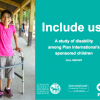
Include Us! A study of disability among Plan International's sponsored children

Based upon Plan International's dataset of 1.4 million sponsored children, the report compares sponsored children with a disability to those without, from 30 countries worldwide. The report, produced in collaboration with London School of Hygiene & Tropical Medicine, reveals that children with disabilities in developing countries are being held back from an education. The findings will help Plan International - and other researchers and organisations - to improve responses to the needs of children with disabilities, particularly their health and education.

Rapport du Secrétaire général : Question de la réalisation, dans tous les pays, des droits économiques, sociaux et culturels

Dans le présent rapport, le Secrétaire général met en relief le caractère convergent des droits économiques, sociaux et culturels et du cadre dans lequel s’inscrivent les objectifs de développement durable, et souligne combien il est important de respecter les principes de l’égalité, de la non-discrimination et de la responsabilité et d’appliquer une approche des données qui soit fondée sur les droits de l’homme afin de pouvoir mettre en œuvre le Programme de développement durable à l’horizon 2030 conformément aux obligations des États en vertu du droit international.

Suivi des Recommandations des Nations Unies en Matière de Droits de l’Homme - Guide pratique pour la société civile

Publié par le Haut-Commissariat des Nations Unies aux droits de l’homme (HCDH), ce Guide montre comment la société civile (ci-après dénommée SC) peut assurer le suivi des recommandations formulées par les mécanismes, mandats ou organes des Nations Unies (ONU) dans le domaine des droits de l’homme.

Contrôler le droit à l'éducation des filles non-scolarisées en Tanzanie

La Tanzanie a l'un des taux de mariage d'enfants les plus élevés au monde. Selon le Fonds des Nations Unies pour la population, 37% des filles sont déjà mariées lorsqu'elles atteignent l'âge de dix-huit ans. En Tanzanie, comme dans de nombreux autres pays, le mariage d'enfants marque la fin de l'éducation d'une fille. Les filles sont forcées d'abandonner l'école ou n'atteignent pas l'enseignement secondaire.

Date: 
25 Juillet 2016

The Right to Education: Leaflet

As an integral part of UNESCO’s Constitutional mission for ensuring “full and equal opportunities for education for all”, the realisation of the Right to Education is one of the biggest developmental challenges, as millions of children and adults remain deprived of basic education in today’s learning societies.

This document is a short leaflet on the right to education.

Combating Discrimination in Education: Guidelines for the Preparation of Reports, Ninth Consultation of Member States on the Application of the Convention and Recommendation Against Discrimination in Education

These Guidelines are intended to assist Member States in the preparation of the Reports on the implementation of the 1960 Convention against Discrimination in Education (“the Convention”) as well as the 1960 Recommendation against Discrimination in Education (“the Recommendation”). The Convention and the Recommendation, adopted by UNESCO’s General Conference in 1960, correspond to UNESCO’s constitutional mandate to “advance the ideal of equality of educational opportunities without regard to race, sex or any distinctions, economic or social”.

La promoción de los derechos en las escuelas: ofreciendo educación publica de calidad

Con el objetivo de facilitar la participación activa de padres, niños y niñas, profesores y profesoras, sindicatos, comunidades y organizaciones locales de la sociedad civil en el seguimiento colectivo y la mejora de la calidad de la educación pública, Promoviendo los Derechos en las Escuelas o PRS  por sus siglas en inglés (Promoting Rights in Schools) ofrece un conjunto de herramientas prácticas que pueden ser utilizadas como base para la movilización, abogacía, incidencia y campañas.

Pages